Pasadena Playhouse’s “Amadeus” Pits Salieri Against His True Enemy, Oblivion
Photography by Jeff Lorch.
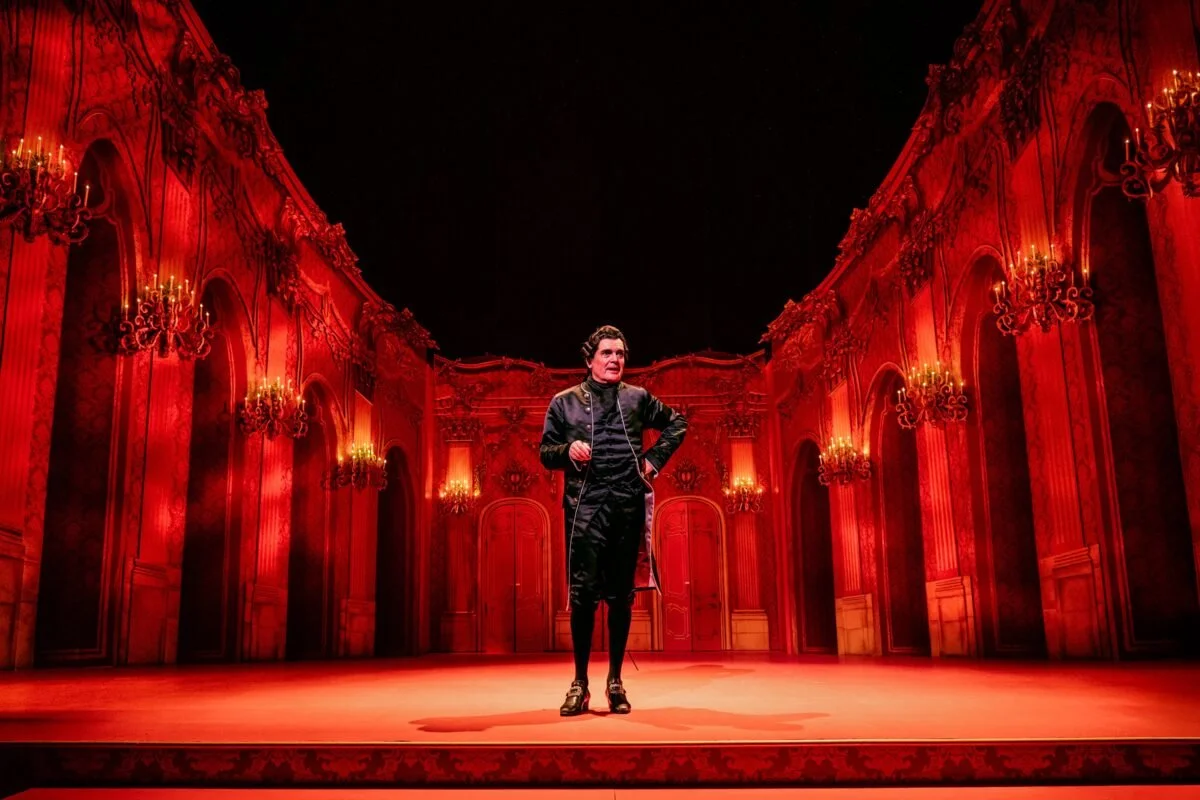
When Pasadena Playhouse’s production of Amadeus first opened on February 15, they had already extended its run due to popular demand. Peter Shaffer’s 1979 play about the rivalry between classical composers Wolfgang Amadeus Mozart and Antonio Salieri has grown in popularity over the years, particularly due to the popularity of Milos Forman’s acclaimed 1984 film adaptation. Forty-one years after the film took home 8 Academy Awards, this story has returned to Los Angeles via Pasadena Playhouse’s newest production. Directed by Tony Award-winner Darko Tresnjak and starring Tony Award-winner Jefferson Mays as Salieri, there was bound to be high expectations around this production. Now that I have seen it myself, I can say that it has successfully met and exceeded those expectations. Through lavish stage design and gripping performances, the Pasadena Playhouse has effectively breathed another life into Amadeus for a new generation.
Photography by Jeff Lorch.
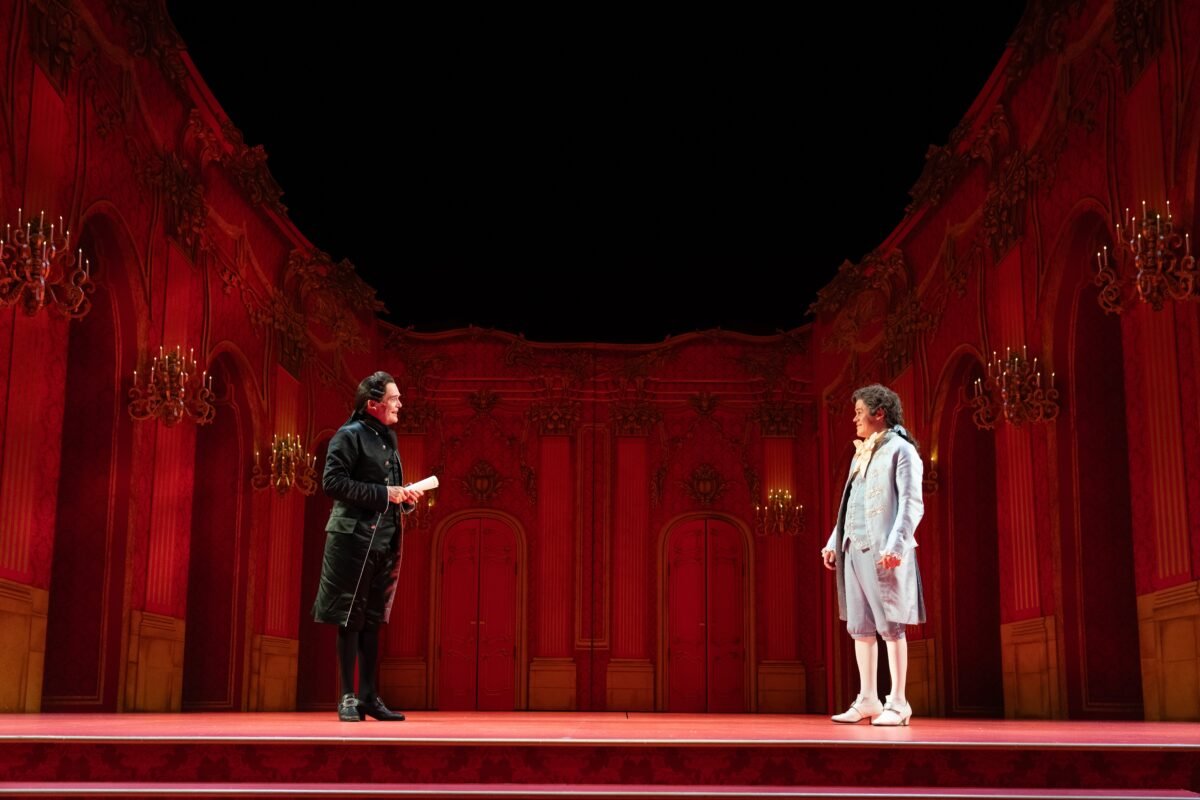
The play begins with the Venticelli–our chorus played by Hilary Ward and Jennifer Chang–gossiping about Salieri’s supposed involvement in Mozart’s death. All of this occurs in front of a translucent curtain adorned with the handpainted musical notes of Mozart’s “Phantasie für eine Orgelwalze” composition. With a simple design and blocking choice, director Tresnjak and scenic designer Alexander Dodge set the stage for the struggle inherent in Mozart and Salieri’s intertwined story. Mozart’s legacy manifests within his music, whereas Salieri’s exists in whispered rumors. It is after this curtain is lifted that we see Jefferson Mays as the aged Salieri, sitting on a wheelchair and waxing sorrowfully to us about his past. He looks and sounds haunted by the ghost of the man whose name and music decorates the stage. Once we are introduced to Sam Clemmett’s jittery, lively, in-over-his-head Mozart, do we see the brilliance of this haunting in plain view.
Photography by Jeff Lorch.
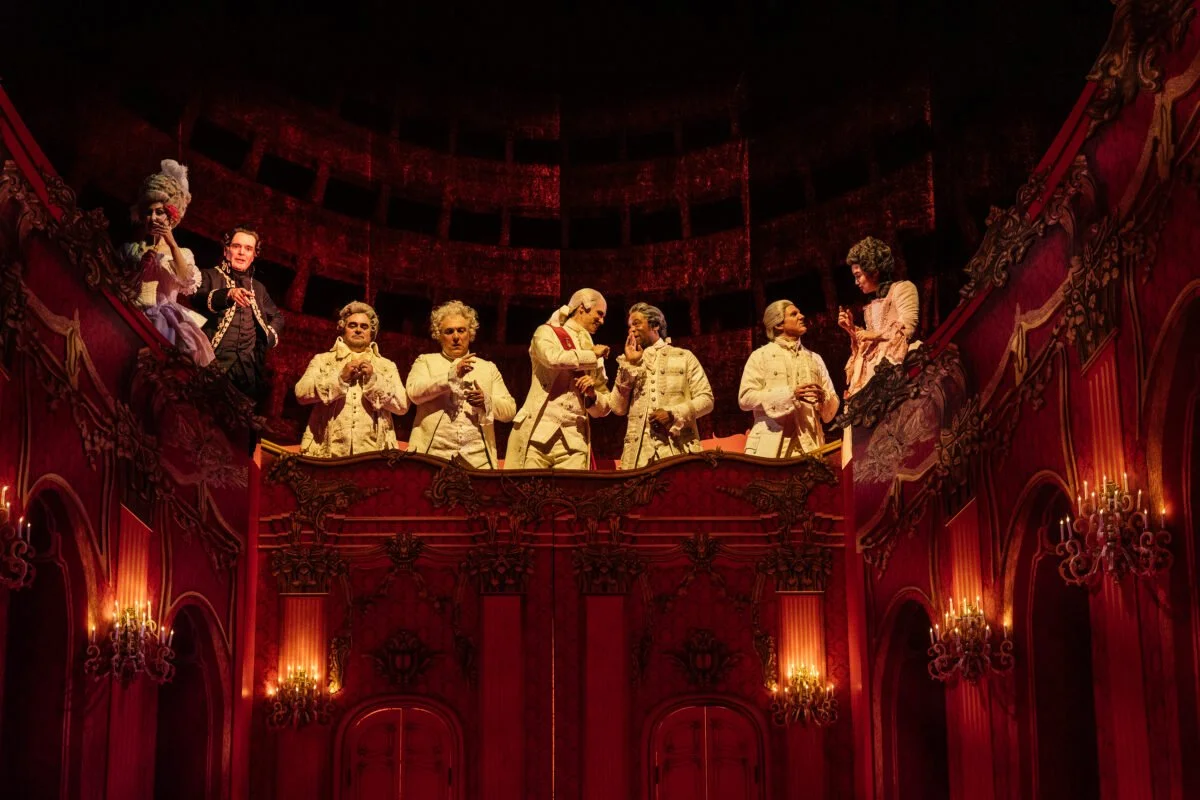
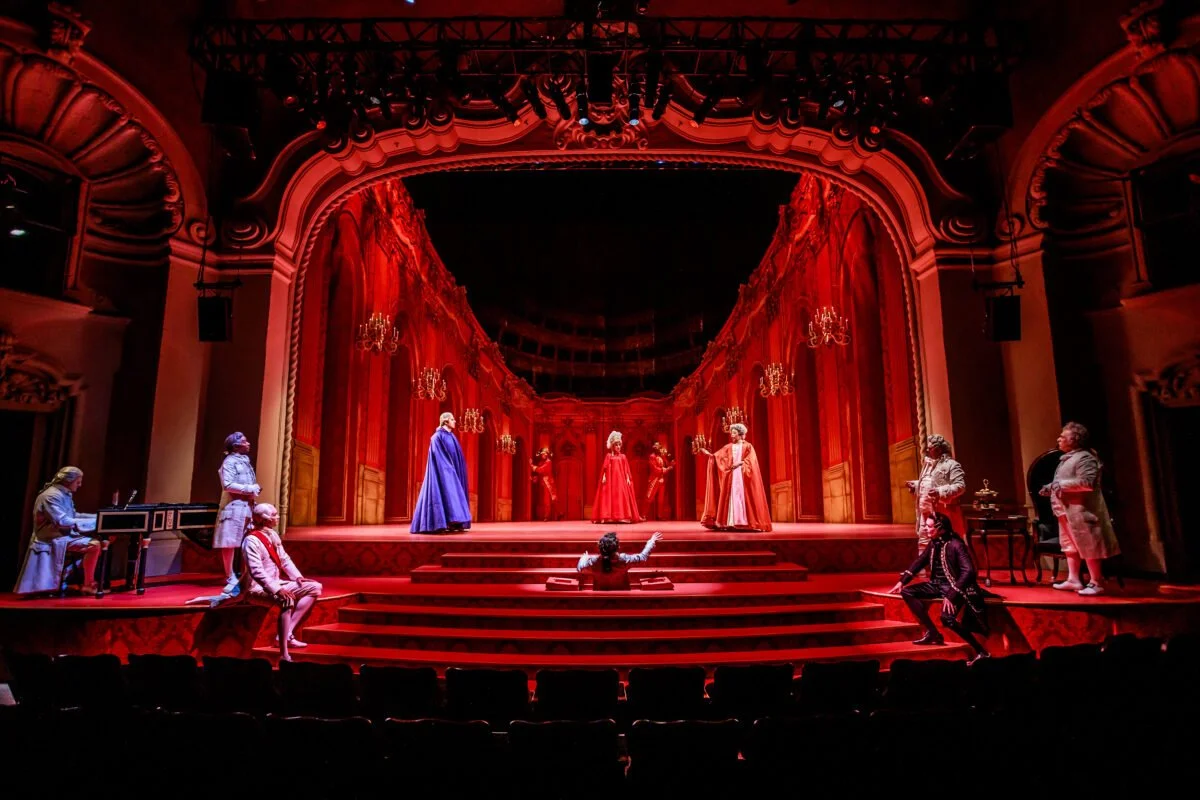
The stage, designed by the award-winning stage designer Alexander Dodge, provides two floors where these characters can interact. Many characters would appear on this upper level, peering down at whoever would perform or otherwise be the subject of their attention. Even the figures who haunt Mozart linger up there, peering down at him. Mozart himself never appears up there. It is a subtle but crucial element of this staging, showing how little control or power the young composer has, and how it is slowly stripped from him. Combined with the very visual displays of these power dynamics is the captivating performance of Sam Clemmett as Mozart.
The breadth of emotional performance required to encapsulate the soaring highs and desperate lows of Shaffer’s Mozart is expansive, and Sam Clemmett has been chosen well to do so. As Salieri takes the reins of every single scene, Mozart is stripped of all power and status–what little his talent could provide for him up until that point. As opposed to Tom Hulce’s buoyant cheeriness in the 1984 film, Clemmett’s Mozart has a slightly more grounded feel even throughout his earlier excitement. It is more naive than silly, which ultimately gives way to an even more devastating downturn in the latter half of the play. While we see beautiful performances of some of his famous works, the ever-increasing financial burdens on the young composer’s shoulders weigh heavy on the audience at large. There is nowhere to escape within Salieri’s story, and yet, a standout performance tries to fight back. That is Mozart’s own wife Costanze, played by Tony-award nominee Lauren Worsham.
Throughout the play we see Costanze stand up for Mozart, doing everything she can to help his career. She even goes to Salieri by herself while being keenly aware of his devious nature. Worsham presents a woman who fundamentally understands the powers at play within any given scenario, and does her best to make calculated moves within them. Amongst the powerhouse performances by Mays and Clemmett, Worsham holds her own with a thoroughly compelling embodiment of a young woman fighting for the right to a better life. She stands her ground against Mozart, Salieri, and the entire court. Lauren Worsham brilliantly embodies Costanze, this figure stuck between the two composers’ rivalry, bringing depth and understanding to her character.
Photography by Jeff Lorch.
Jefferson Mays as Salieri remains the titular and constant performance of the night. He impressively transitions from the ailing old man of the present-day to the stoic court composer of 30 years past. This is not to say he simply puts a wig on and takes a layer of clothing off, which he indeed does do. What truly impressed me during these transitions was how he would change the quality of his voice in an instant. Mays’ performance for the rest of the play is gripping as he at once describes his terrible deeds and appeals to the audience for understanding. My main critique of his performance would be within the ways he defaulted to screaming when performing as angry. While this in itself is not an issue, there was a distinct lack of range of emotional performance within the many times Salieri expressed his anger. While Salieri very eloquently tells us of his woes throughout the night, I would have liked to have felt that more from Mays’ performance beyond the words he said. Mays gives us an accessible Salieri whose desperation is clear even beyond the bounds of the play, but out beyond the fourth wall. Overall, it is an engaging performance that exposes Salieri’s own desperation to be understood.
Within Amadeus exists a throughline of tension between Mays’ Salieri and the audience. What has ultimately brought all of us to this theater isn’t him but Mozart’s own name, “Amadeus.” At once a calculating teacher and a screaming maniac, Salieri is presented here as having one ultimate fear–oblivion. Mays deftly plays into this, threading the needle between the trusted court composer and the frantically jealous man doing everything he can to remain on top. Although he has exchanged his need for fame with that of infamy, Salieri still yearns for absolution–from Mozart, from his peers, and ultimately, from us the audience. We are the living proof of Mozart’s reach, and in turn, of the mediocre historical footnote that is Salieri’s own musical oeuvre. By breaking the fourth wall to discuss his motivations with the audience, Mays’ Salieri shows how deeply concerned he is that the audience know his story well, that they understand why he did what he did and, in turn, absolve him. It is the ultimate irony of the play–that it ends with the remaining husk of Salieri, clinging to fame by mere proximity as Mozart’s rumored killer. Darko Tresnjak has breathed a new life into Peter Schaffer’s story of legacy and mediocrity, bringing a galvanizing tragedy to the Pasadena Playhouse’s stage.
Amadeus is playing at the Pasadena Playhouse until March 15, 2026. You may find tickets to the remaining performances at pasadenaplayhouse.org.